Benjamin Sesko’s injury has exposed a thin spot in Manchester United’s attack, and Inter Milan forward Marcus Thuram looks like one of the few plausible January options. Reports cited by The Sun say United are considering an emergency signing because Sesko could miss up to four months. That would leave the club weighing the cost of a midseason move against the disruption of asking its existing forwards to cover for an extended spell.
Marcus Rashford or Matheus Cunha could fill in at centre-forward in the short term. But neither being a possible stopgap answers the bigger question: how does United maintain a focal point through a lengthy absence? Relying on makeshift options could leave Michael Carrick’s squad without a natural No. 9, adding pressure to a team already struggling through a difficult start to the season.
That distinction matters. A temporary solution can get a side through a match or two; a prolonged shortage can affect how the attack functions from week to week. United would have to decide whether its current options can absorb that change, or whether a specialist forward is worth pursuing in a market where timing and availability may matter as much as ability.
Why Thuram fits United’s shortlist
Recruitment analytics firm SciSports identified 13 potential Sesko replacements for United, assessing how their profiles match the striker’s strengths in finishing, passing and holding the ball. The list includes names such as Harry Kane, Alexander Isak and Joao Pedro, but a January move for them appears unrealistic. Ollie Watkins, Robert Lewandowski and Goncalo Ramos are also unlikely targets after moving clubs in the summer.
The shortlist illustrates the limits of a data led search. A player can resemble Sesko in selected areas and still be unavailable, unaffordable or difficult to recruit midseason. The exercise is useful for narrowing the field, but it doesn’t settle the practical questions that determine whether a transfer can happen.
Thuram is a more attainable candidate. The 29-year-old is behind Lautaro Martinez in Inter’s forward pecking order, though Martinez’s hamstring injury has put Thuram in the starting lineup. He has scored four goals in six Serie A appearances this season.
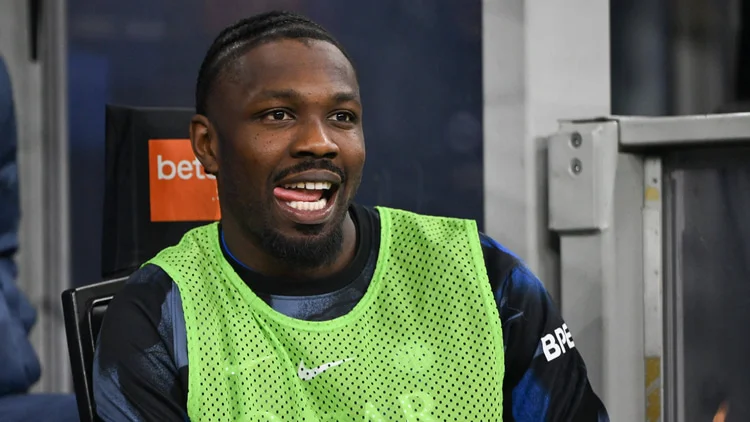
His physical style and ability to link play resemble the platform Sesko offers in attack. SciSports gives Thuram a SciSkill rating of 118.4, higher than any current United player; the score draws on hundreds of in-game data points. For United, he could bring immediate experience while offering a model for Sesko to learn from after returning.
This is more significant than it looks: United wouldn’t be assessing Thuram only as a replacement for the injured striker. The case also rests on whether his experience and style could add value once Sesko is back. That’s a longer-term argument, though, and the available information doesn’t establish how the two would fit together in the same side.
The rating deserves similar restraint. A score built from many data points can help compare profiles, but it can’t guarantee that a player will reproduce his output in a new team or role. Here's the thing: United would still be buying a footballer, not a spreadsheet result.
Inter’s price and timing
A deal would be complicated by Inter’s own priorities. The club is expected to compete for the Serie A title while also playing in the Champions League, giving it reason to keep a proven forward through January. Thuram’s current place in the starting lineup, following Martinez’s injury, makes the timing more difficult still.
Inter’s depth could make a sale possible at the right price. Pio Esposito, 21, scored seven Serie A goals last season and has become more prominent this term. The squad also includes Ivory Coast international Ange-Yoan Bonny.
Those options give Inter cover, but depth alone doesn’t mean the club is ready to sell. A midseason departure would still leave Inter deciding how much it values Thuram’s contribution during a campaign with domestic and European demands. If you're working in this space, that’s the distinction to watch: a player’s theoretical replaceability isn’t the same as a club’s willingness to accept an offer.
Reports earlier this year said Inter might consider selling Thuram amid financial factors and the emergence of Esposito and Bonny. The club was reportedly prepared to negotiate around €60 million, above Thuram’s Estimated Transfer Value of €45.6 million. That figure suggests a deal could be discussed, though United would need to meet Inter’s terms.
The gap between the reported asking figure and the Estimated Transfer Value signals a potential point of friction, not a settled price. The estimate is a reference point; Inter’s reported position is the more direct indication of what it might demand. United would need to judge whether Thuram’s short-term cover and possible longer-term role justify that outlay.
What the move would mean for United
Sesko’s absence makes United’s need clear, but the January market may offer few realistic fits. Thuram’s profile and Inter’s depth make him a credible name to watch if United decide to act. Yet the fit only becomes meaningful if United can agree terms and sees a role for him beyond filling a vacancy.
That said, waiting also has a cost: the club would be committing to its current forward options for as long as Sesko is unavailable. No transfer can remove the uncertainty around his recovery or guarantee an immediate contribution from a new signing. A calculated stopgap, with all the complications that entails.
What this means for United is a choice between tolerating a thin position and pursuing a deal that Inter may have little reason to make easy. Thuram appears to meet more of the practical and playing criteria than several names on SciSports’ list, but the evidence points to a possibility, not a likely outcome.