Vinicius’ place at Real Madrid faces fresh scrutiny
Real Madrid’s recent results have sharpened a question Arsenal may be watching closely: how essential is Vinicius Junior to the team’s attack? The Brazilian remains an elite forward, but his modest output this season and Yan Diomande’s form have made his place look less assured. A few strong results don’t settle the matter; they do give Madrid reason to assess whether its attack works best with Vinicius at the center of it.
Vinicius, 26, has recorded four goal contributions in 11 matches across all competitions in 2026-27. That return stands out against his reputation and comes despite a lucrative contract extension. Spanish reports say the deal hasn’t settled doubts about his long-term future at the Bernabeu. A contract can provide security for both player and club, but it doesn’t answer questions about role, playing time or whether the sides still share the same sporting priorities.
Jose Mourinho added to the speculation last week, saying Vinicius might have been better off leaving during the summer. “If I were in his shoes, I probably wouldn't be here,” Mourinho confessed to reporters. “I would have forced a move to a country where I'd be respected, but out of loyalty to Real Madrid and love for the club, he stayed.” Mourinho’s view is an outside assessment, not evidence that Vinicius wants to leave. Still, his comments underline how a player’s status can look unsettled even after a major contract commitment.
Arsenal’s interest depends on Madrid’s decision
Arsenal had targeted Vinicius before the 2026-27 campaign as they sought a left winger. Replacing Gabriel Martinelli remains a priority after the club failed to bring in a successor before Transfer Deadline Day. Kenan Yildiz, Kevin Schade and Alex Baena are among the other players on Arsenal’s radar, according to FootballTransfers’ reporting. That range of names suggests the club is considering more than one profile for the position, rather than waiting on a single target.
A move for Vinicius could enter the picture if Madrid make him available. That condition matters: a dip in output or a strong spell from a teammate doesn’t, by itself, mean a club will sell a player of his standing. Any potential deal would depend on Madrid’s view of its attack and whether the player’s future becomes an active question. For Arsenal, the appeal is clear, but so is the uncertainty.
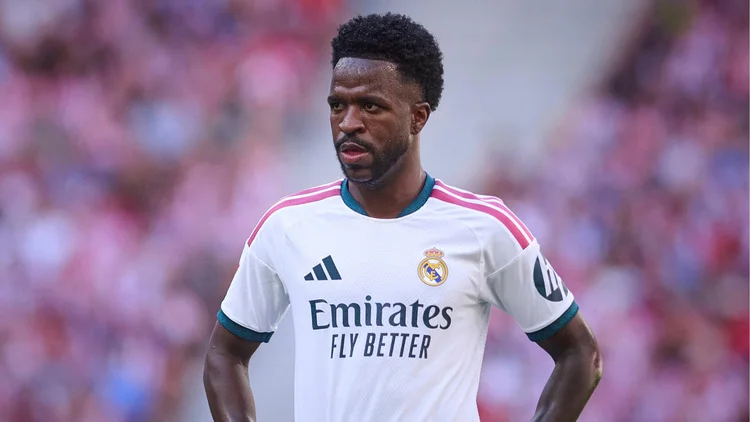
Diomande changes the equation
Madrid’s results offer a case for reshaping the front line. The team came from behind to beat Roma after Vinicius was substituted, then defeated Sevilla and RB Leipzig. Those results don’t prove that removing Vinicius caused the improvement, but they do complicate the assumption that Madrid’s attack depends on him to produce. In football, a run of wins can quickly turn a tactical question into a question of selection.
Against Leipzig, Vinicius returned to the starting lineup after missing the Sevilla match through suspension, but left in the 69th minute without a goal or assist. Diomande, who replaced him, assisted Kylian Mbappe and scored four minutes later. The sequence gave Madrid an immediate return from its change, though one match can’t establish which player should own the position over a longer stretch.
The Ivorian now has three goals and three assists across his last four Madrid appearances, playing on the left wing. That form gives the club a productive option in Vinicius’ position. The numbers here make a strong case for Diomande’s current contribution, but they don’t erase the difference between a brief run of form and the sustained value expected from a leading forward.
There’s also the fit with Mbappe to consider. The two stars have sometimes crowded each other out, while Mbappe appears more comfortable when he has greater room to lead the attack. Diomande’s recent performances suggest he may complement the French forward more naturally as he settles in at the Bernabeu. And yet, a smoother pairing over a handful of appearances doesn’t guarantee that the balance will hold as opponents adapt or the roles change.
What Madrid’s choice could mean
Vinicius’ importance over recent seasons is clear, but Madrid’s latest run has shown the attack can function without him. This is more significant than it looks: when a club has a capable replacement in the same position, it gains tactical options and may feel less pressure to build every attack around one player. That shift can affect a player’s role even if he stays.
If you're working in this space, the key signal isn’t one substitution; it’s whether Madrid continues to trust Diomande in high-profile matches and how the front line performs together. (And this is the part most people overlook: a productive alternative can change the club’s negotiating position before any transfer is on the table.) The evidence so far is suggestive, not decisive.
If Diomande keeps producing and the club can command a substantial fee, a 2027 departure could suit Madrid’s changing front line—and give Arsenal a chance to revisit their interest. For now, that remains a possible outcome rather than an established plan. The immediate test is whether Madrid sees its recent results as a short-term run or as a reason to rethink Vinicius’ place. A question of fit, too.