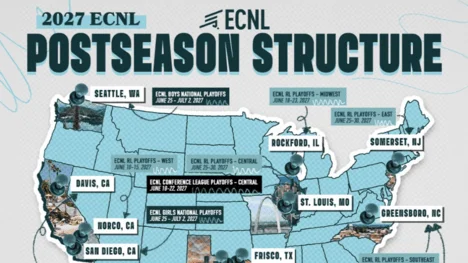
ECNL’s 2026/27 postseason will bring nearly 2,500 teams into three playoff pathways, extending competition across national, regional and conference levels. The league describes the expanded schedule as the largest end-of-season competition in American youth soccer history, a claim that signals the scale it wants clubs and families to associate with the new format. The number of teams matters, but the structure matters more: it creates several routes through the postseason, with different levels of competition and different destinations for teams that advance.
The events are set for June and July 2027 and include the ECNL Playoffs, ECNL Regional League Playoffs and a new Conference League competition run with National 1 League. ECNL President Christian Lavers said the integrated format is intended to widen opportunities for competition and exposure. He added that clubs could use their results to pursue future league and event placements. That gives the postseason a role beyond deciding champions: results may also become part of how clubs make a case for where they belong in later seasons.
Three routes, one expanded postseason
For families, the format’s practical effect will depend on which pathway a team enters and how far it advances. A national event promises a different test from a regional tournament, while conference competition brings together qualifiers from two league structures. More entry points may give clubs additional ways to compete, but the number of pathways also makes the overall schedule harder to understand at a glance. The value of the expansion will rest on whether teams can see a clear route through it.
There’s a distinction between offering more competition and making that competition more meaningful. A larger schedule can give more teams a postseason destination, but the quality of the experience will also depend on the matchups, travel demands and how clearly advancement is defined. The announcement lays out several of those mechanics; it doesn’t yet establish how clubs will compare results across pathways when seeking future placements. That question is likely to matter to teams weighing where to direct their time and resources.
National events return to Seattle and San Diego
The top-tier boys’ playoffs will return to Seattle, while the girls’ event will be held in San Diego, from June 25 to July 2. Each is expected to draw more than 300 teams. U13 to U17 teams will play group and knockout stages, with finalists advancing to the ECNL Finals in July. That format gives younger age groups multiple opportunities to progress: teams first have to navigate group play, then win through elimination rounds to reach the final stage.
At U18/19, boys’ teams will compete in separate National Championship and North American Cup brackets. That split creates more than one title route for teams at the oldest age group, though the announcement doesn’t detail how clubs will be assigned to each bracket. The girls’ tournament will run from quarterfinals to a final in San Diego. Its schedule also includes a North American Cup and two Showcase Cups for U15 to U17 teams.
Those parallel competitions suggest the event is designed to serve teams with different competitive aims, not just the finalists in the main bracket. Showcase Cups, in particular, add another kind of destination for younger teams. And this is the part most people overlook: a postseason can have value for a club even when its team doesn’t reach the final, provided the games and event setting meet the club’s goals. The announcement names the competition formats, but leaves the quality of those experiences to be judged once teams take the field.
Regional and conference routes expand
The Regional League Playoffs will grow to six regional events, giving teams more entry points while reducing travel for families. U13 to U17 winners move on to July’s Regional League Finals; U18/19 champions will be decided at their regional events. The age-group distinction is significant. For younger teams, the regional event is a step toward a further final, while the oldest teams will settle their titles at the regional stage.
Regional sites can make a long season more manageable for families by limiting how far teams need to travel for the first playoff stage. Still, the announcement doesn’t say how locations will be assigned or how much travel families can expect in practice. The promise of reduced travel is relative: teams that advance to a later final may still need to make another trip. For clubs, that means planning around a sequence of possible events, rather than treating the initial playoff as the only postseason commitment.
The new Conference League Playoffs will bring together Regional League qualifiers and leading National 1 League teams. Group and knockout play will take place at four regional sites, with winners advancing to July’s Conference League Finals. At U18/19, eight National 1 League teams at each event will compete for titles decided on site.
Combining qualifiers from different league structures gives the conference competition a distinct purpose: it puts teams from those routes into a shared postseason. That could make the results useful to clubs assessing their standing beyond their usual schedule. The details will matter, though. The announcement identifies who will take part and how the tournament will run, but doesn’t explain the criteria for Regional League qualification or what makes a National 1 League team “leading.” Clarity on those points will shape how teams understand the opportunity.
What the expansion could mean for clubs
The announcement lands amid intensifying competition among US youth soccer platforms; MLS NEXT has also reported record numbers for its 2026-27 season. That wider context helps explain why postseason scale and visibility are part of the pitch. Leagues compete for clubs, players and attention, and a large end-of-season event can give a platform a prominent way to show what its membership offers. The headline team count is striking, but the more useful measure will be whether the different routes deliver meaningful competition for the teams involved.
This is more significant than it looks for clubs trying to plan a season. If you’re working in this space, the key question isn’t simply how many teams can enter; it’s how each pathway connects to later opportunities and what results will mean when placements are considered. Lavers’ comments point to that connection, while stopping short of setting out a placement policy. That leaves clubs with a broad promise and several tournament details, but not yet a complete account of how postseason performance will translate into future access.
For families, the expanded calendar could mean more chances for a team to compete after its regular schedule ends, along with new travel and scheduling decisions. For players, the stated aim of wider competition and exposure is appealing, but the announcement doesn’t define how exposure will differ across the three pathways. The structure is now on the table. Its value will depend on how well the events serve teams at each level, and whether the routes stay understandable as clubs make plans for 2027.
Contact the writer of this story, Nick Webster, at [email protected]