Brentford’s draw at Hull offered Fantasy Premier League managers three distinct signals: Igor Thiago is building form, Kevin Schade had a poor afternoon, and Mamadou Sangare’s defensive contribution numbers remain strong despite doubts over his minutes. The match also gave Hull reasons for cautious encouragement, with a more competitive display and Oli McBurnie opening his account. For FPL decisions, though, the central question is how much weight to give one performance when fixtures and expected playing time point in different directions.
Thiago’s form meets a difficult fixture run
Igor Thiago (£7.8m) has registered an assist in each of his last three matches, after scoring his first goal of the season against Chelsea in Gameweek 5. At Hull, he pounced on Ryan Giles’ 63rd-minute clearance and nudged the ball into Dango Ouattara’s path for a tap-in. The sequence showed Thiago getting into a useful position and reacting quickly when the clearance fell short; it also extended a run of returns that managers can assess alongside his broader involvement.
Thiago ranks fourth among individual players for expected goal involvement, with an xGI of 4.95. That makes him a plausible replacement for Joao Pedro (£7.9m) if the latter’s injury rules him out. The case for a move is strongest for managers who prioritize current form: Thiago has produced a steady stream of attacking returns across recent matches, and his underlying xGI supports the view that he’s involved in meaningful chances. Those weighing fixtures more heavily will have reservations: Brentford sit bottom of the Fixture Ticker for the next six Gameweeks. Form can justify a transfer, but a difficult run raises the bar for expecting that form to continue at the same rate.
Schade’s quiet outing raises a transfer question
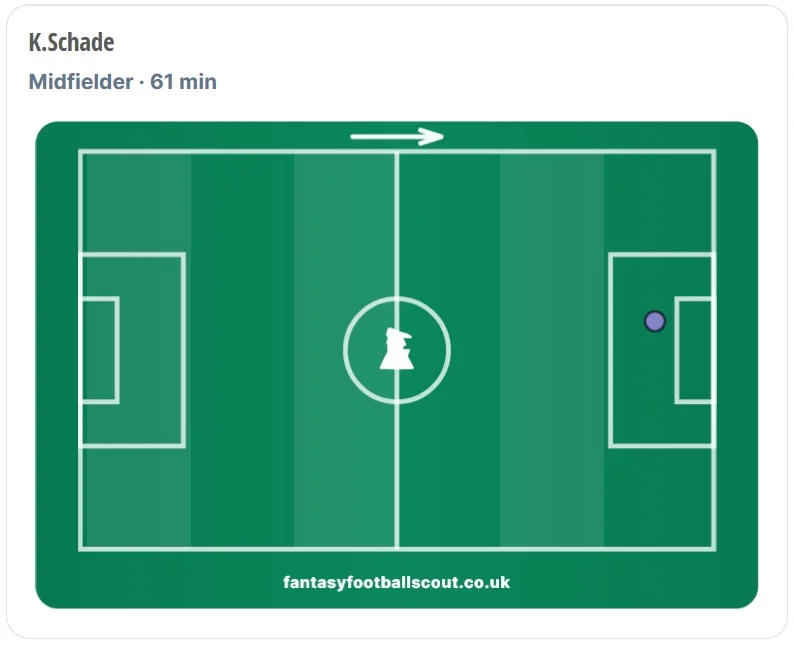
Kevin Schade (£6.2m), a popular recent pick, made little impact. He created no chances, and his only shot came from close range after Ouattara’s pull-back. Thiago blocked the effort before it could reach goal. For managers who brought Schade in for attacking output, the match offered little reassurance about his role in Brentford’s chance creation on this occasion.
Ouattara was far more involved, recording three chances created, four attempts and two big chances. Schade was also the player taken off when Jaidon Anthony (£5.9m) came on; Anthony then supplied the cross that Giles failed to clear. That substitution and assist are relevant clues about how the attack developed, though one match can’t establish a lasting change in the pecking order. Managers considering a sale can look at similarly priced alternatives Marcus Tavernier (£6.3m) and Johan Manzambi (£6.0m), but should compare their own squad needs and transfer plans before reacting. The numbers here are underwhelming. One quiet match alone doesn’t settle the decision.
Sangare delivers again, but minutes are the concern
With Vitaly Janelt (£5.0m) and Yehor Yarmoliuk (£4.8m) suspended, Mamadou Sangare (£5.5m) returned to Brentford’s starting line-up. He didn’t shoot, but logged 20 defensive actions, comfortably clearing the 12-action threshold for defensive contribution points, or DefCon. He’s averaging 15.5 such actions per 90 minutes. That profile gives him a route to points even when he makes little attacking contribution, a useful distinction for managers weighing cheaper midfield options on more than goals and assists.
The catch is playing time. Every match in which Sangare has played more than 45 minutes has brought a DefCon return, but Sunday was his first such appearance since Gameweek 4. Yarmoliuk is also set to miss next Saturday’s match, giving Sangare a chance to hold his place. Whether that becomes a regular role remains uncertain. The pattern is promising, yet the sample described here is tied to minutes played; a strong rate per 90 doesn’t help much if he’s often substituted before reaching the threshold.
Hull show improvement as McBurnie opens his account
Michael Kayode (£4.6m) and Hull’s Semi Ajayi (£4.2m), John Egan (£4.1m) and Mohamed Belloumi (£5.2m) also reached the DefCon threshold. Belloumi added four attempts, including a side-netting effort after a sharp turn. The defensive-action returns may attract managers looking for points from less obvious sources, while Belloumi’s attempts suggest he was also willing to test the opposition. Neither detail alone makes a player a priority, but both add texture to the match beyond its goals.
The expected-goals figures pointed to a draw, extending Hull’s unbeaten home run and Brentford’s unbeaten, but still winless, away record. Hull’s display was a step up from their Gameweek 7 loss at Fulham. Sergej Jakirović’s side now host Ipswich Town next week looking for a stronger result. That improvement is encouraging, though the result itself leaves Hull with work to do: a more convincing performance matters most if it can be followed by another competitive showing.
The opening goal came after Caoimhin Kelleher (£5.0m) played Aaron Hickey (£4.5m) into trouble. Hickey fouled Tim Iroegbunam (£5.0m) in the box, and Oli McBurnie (£5.5m) converted the penalty for his first goal of the season. Joe Gelhardt sent a late chance wide, while Konstantinos Tzolakis (£4.7m) made five saves to take his season total to a league-leading 31. A goalkeeper’s save count can reflect both shot volume and the work required to keep a side in a game; Tzolakis’ tally underlines his activity, though it doesn’t by itself predict what comes next.
What the match means for FPL managers
Here’s the thing: this match doesn’t produce one clear transfer instruction. Thiago’s returns and xGI make a credible case for consideration, but Brentford’s upcoming fixtures complicate the timing. Schade’s quiet outing gives managers a reason to review his place, while Sangare’s DefCon record is only as useful as his minutes. If you’re working in this space, the practical choice is to distinguish a repeatable role from a single match’s events.
Hull’s improvement adds context, but FPL decisions still depend on what players are likely to do in their own teams. A penalty, a blocked shot, or a high defensive-action total can shape a gameweek without settling a player’s longer-term value. That’s the part most people overlook (and this is the part most people overlook): a useful signal is not the same as a reliable trend. For now, keep the evidence in view—and the uncertainty, too.