Real Madrid’s 2-1 win at Barcelona gave Jose Mourinho a compelling selection argument: the team looked dangerous without Vinicius Jr, while Yan Diomande made a strong case to keep his place. Vinicius celebrated the result on social media, but the performance may leave him with more to consider than Barcelona’s defeat. For Mourinho, the match offered a practical demonstration of what Madrid can do with a different left-sided threat. One win doesn’t settle a selection debate, but it can change the terms on which that debate is held.
Madrid found a way to blunt Barcelona
The result carried more weight than the pre-match form suggested. Barcelona had been scoring freely in LaLiga, and Real Madrid had looked uneven for much of the season. The Catalans also arrived seeking a response to their midweek loss to reigning European champions PSG, which gave the home side another reason to impose itself early. Madrid had to manage both Barcelona’s attacking confidence and the expectation that it would take control at home.
Instead, Madrid’s approach disrupted Barcelona’s midfield. The visitors restricted the influence of Rodri and Pedri, helping them control the game’s early stages and limiting Barcelona’s ability to build its usual rhythm through the middle. That kind of control can matter even when a team doesn’t dominate possession: it narrows the opponent’s options and gives the defending side a clearer route into the match. Madrid’s early threat suggested the plan was working.
Barcelona improved after the break and took charge following their equaliser to Kylian Mbappe’s fortunate opener. That shift matters because Madrid didn’t simply cruise to the final whistle; it had to withstand a period in which the balance of the game moved towards the hosts. But Madrid settled the contest in the 87th minute, when Eduardo Camavinga beat Pau Cubarsi and set up his compatriot’s second goal. A late winner after Barcelona’s revival made the result more telling than a comfortable victory would have been.
Barcelona remain top of LaLiga, but Madrid’s away win cut the gap between the rivals to three points. The standings keep the title race open, while the performance gives Madrid a reason to trust its approach in a difficult away fixture. Just as striking as the scoreline was the absence of Vinicius, who missed the match while serving the second game of a four-match league suspension. His absence turned a major match into an unusually clear test of Madrid’s other options.
Diomande is making the selection case
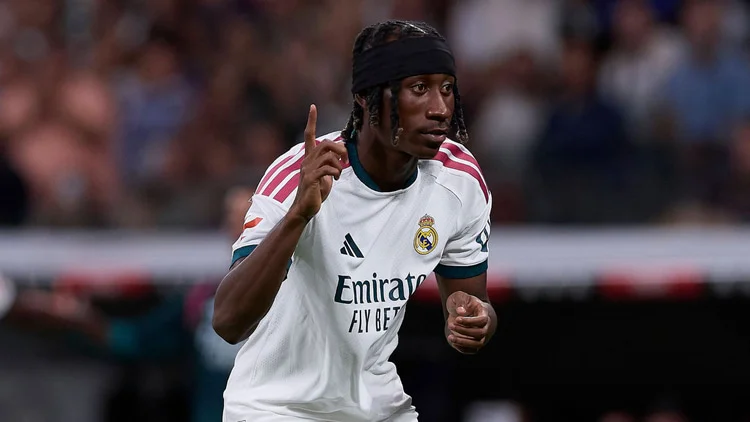
Yan Diomande again impressed in Vinicius’ absence. The 19-year-old has scored three goals and provided three assists across his last five matches, including a volley against RB Leipzig in the Champions League the previous week. That run gives Mourinho more than one isolated performance to consider. It also means the question about Diomande’s role is becoming harder to dismiss as a short-term reaction to a single result.
Against Barcelona, the Ivorian’s pace and direct running troubled the defence. He brought an explosive edge that Vinicius has appeared to lack over the past 18 months to two years, and the source argues that Diomande contributes more defensively as well. The combination matters: a forward who threatens space can stretch a defence, while defensive work can help a team keep its shape when possession changes hands. On current form, a starting place on the left looks deserved.
This is more significant than it looks. A backup’s strong spell can be easy to praise while the regular starter is unavailable; the harder decision comes when both are available and the coach has to choose what the team needs. Diomande’s form has made that choice harder to avoid. If you’re working in this space, you’ll recognize the familiar problem: a manager has to weigh a player’s reputation against the evidence of recent performances.
The complication is the status Vinicius holds at Madrid. Diomande is increasingly justifying his reported €125 million price tag, but changing the lineup would mean a consequential call for Mourinho, given the club’s dressing-room dynamics. The coach has, however, said that no player is guaranteed a place. That statement gives him room to make a selection on form, though it doesn’t remove the pressure that comes with leaving a major player out.
“The only thing untouchable is the badge,” Mourinho said before the Leipzig match, when asked whether Vinicius’ starting role was in danger. “I don't like this concept of an untouchable player. What makes a player untouchable is their performance on the field.” The principle is direct; applying it to a prominent player is where the difficulty lies. Results can strengthen a coach’s hand, but they don’t make the squad consequences disappear.
Vinicius shared Madrid’s full-time post after the Clásico with four crying-laughing emojis. The gesture landed awkwardly against the backdrop of a win that may sharpen the competition for his position. Social media reactions are open to interpretation, so the emojis alone don’t establish what he meant. Their timing, though, made them part of the conversation around a match in which Madrid had just won without him.
Mourinho had also said the previous week that, in Vinicius’ place, he would probably have “forced” a move away from Madrid that summer. That comment adds another layer to an already public dispute over the player’s standing. It doesn’t tell us what Vinicius will do, or what the club will decide, but it makes the coach’s selection policy more than a routine tactical question. And yet, the clearest evidence available remains what happens on the pitch.
Vinicius had the chance to join Arsenal, the reigning Premier League champions, but stayed at Madrid and signed a major new contract. A change of club might have offered a fresh start; instead, his place could now depend more directly on what he produces on the pitch. Diomande’s form has made that choice harder to avoid. For Vinicius, the challenge is to answer the competition through performances rather than rely on status alone.
What the result could mean for Madrid
The match doesn’t prove that Diomande should permanently replace Vinicius, and one strong run can’t answer every question about how the two fit into Madrid’s plans. It does show Mourinho has an alternative who can threaten a top opponent and contribute across the pitch. That gives the coach a real choice, rather than a theoretical one based on training or reputation.
Here's the thing: competition only matters if the coach is willing to act on it. Mourinho’s comments suggest he wants performance to determine selection, while Madrid’s win gives that view a persuasive example. The next step is whether Diomande can sustain his level and whether Vinicius can make the case that the team is stronger with him in the lineup. No guaranteed place. Just the next performance.