A shootout breaks the pattern
Estudiantes de La Plata’s penalty shootout win over Flamengo has ended the prospect of a third straight all-Brazilian Copa Libertadores final. The Argentine side advanced 3–2 on penalties after both legs of their semi-final finished 0–0, becoming the first non-Brazilian finalist since 2023. The result changes the shape of the final, but it also says something about how narrow this tie was: over two matches, neither side managed to settle it in open play.
That distinction matters. A two-leg semi-final usually gives teams time to correct an early mistake, build pressure, or find a more effective way through. Here, the score stayed level across both games, leaving the contest to be decided from the spot. For Estudiantes, that meant surviving a long stretch without a goal and then handling the decisive moment better. For Flamengo, it meant the defending champions’ route to the final ended despite a home crowd behind them.
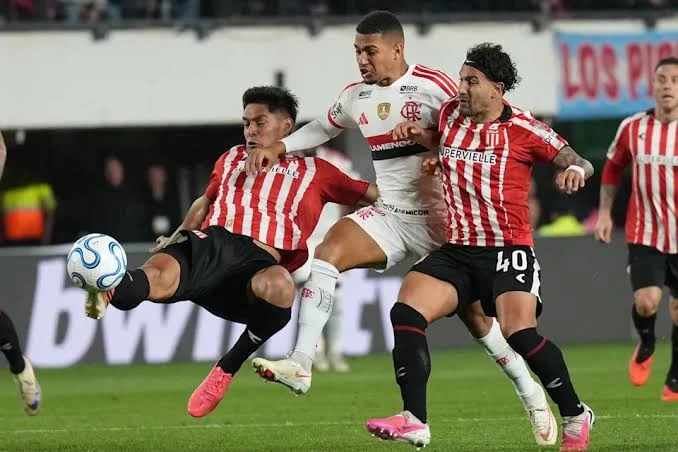
Flamengo had the advantage, but no breakthrough
Flamengo’s Lucas Paquetá, Jorginho and Bruno Henrique all missed from the spot, silencing a packed Maracanã. Three missed penalties make the shootout’s immediate story plain, though they don’t explain the entire tie. Estudiantes had the clearer chances before halftime, but the balance shifted after Baltasar Rodríguez received a second yellow card in the 50th minute. From that point, Flamengo had a player advantage and a clear opportunity to turn control into a goal.
It couldn’t. That failure will sting more than the fact that the match went to penalties. A numerical edge can create more room and more possession, but it doesn’t guarantee that a team will find a clean route through a compact opponent. Estudiantes had to manage the disadvantage, while Flamengo had to make its advantage count. The final score says neither side scored; the circumstances after Rodríguez’s dismissal make that outcome especially difficult for the champions to accept.
For Estudiantes, the task was to keep the tie alive long enough to reach the shootout. That requires discipline and a willingness to endure pressure, particularly in a stadium where the home crowd is invested in every attack. The team’s earlier chances also matter: this wasn’t simply a case of defending from the opening whistle and hoping for penalties. It had threatened before the match turned against it.
And then the shootout. A single miss can change the mood; several can decide the tie. Flamengo’s three failures handed Estudiantes the opening it needed, and the Argentine side took it. This is more significant than it looks: a penalty win can be dismissed as a lottery, but reaching that lottery after two scoreless legs and a second-half dismissal also reflects a team’s ability to stay in the contest under changing conditions.
Medina frames the run as earned
Coach Alexander Cacique Medina likened the result to the Maracanazo. “Our team grew as the Libertadores progressed, and we overcame every other team. Reaching the final was well-deserved,” he said.
The comparison gives the victory a larger emotional frame, but Medina’s account also points to the work behind it. He described a side that improved as the competition went on and treated the final as the result of that progress. His claim that the place was deserved is a coach’s judgment, naturally, but Estudiantes’ performance in this tie gives it some basis: the team created the clearer chances before halftime, then held on after losing a player.
That said, a coach’s assessment doesn’t settle what the final will look like. Estudiantes will arrive with the confidence that comes from surviving a difficult semi-final, but the scoreless nature of the tie leaves open questions about its attacking threat. The shootout showed composure at the decisive point; the final will demand a different kind of answer over the course of a match.
Palmeiras await in Uruguay
Estudiantes will meet Palmeiras in the final on November 29 at Montevideo’s Centenario Stadium. Palmeiras also advanced through a shootout, eliminating Fluminense. The finalists therefore share one feature: each needed penalties to get through its semi-final. That offers a useful bit of context, though it doesn’t mean the final itself is likely to follow the same script. A shootout is an outcome, not a reliable preview of how two teams will approach a match.
The final gives Estudiantes a chance to revisit a defining rivalry: the club won its first of four Libertadores titles against Palmeiras in 1968, beating the Brazilian side 2–0. That history gives the matchup an extra layer, but it can’t decide the present. The result from 1968 belongs to a different campaign; its value now is as a reminder that these clubs have met in a consequential setting before, and that Estudiantes has already beaten this opponent in a Libertadores final.
A victory this time would make Estudiantes the first non-Brazilian club to win the competition since River Plate in 2018. That possibility gives the final significance beyond the two clubs involved. Brazilian teams have accounted for the last two finals, and Estudiantes’ advance has already interrupted the prospect of another all-Brazilian meeting. Winning the trophy would take the shift further. Reaching the final alone doesn’t make that outcome inevitable.
What the result sets up
If you’re following the competition as a contest between clubs from different countries, this result gives the final a sharper edge. Estudiantes carries the chance to break a recent run of Brazilian winners, while Palmeiras has the opportunity to keep the trophy with a Brazilian side. Those are stakes created by the supplied history, not a guarantee of what either team will do in Montevideo.
Here’s the thing: both finalists have already shown they can survive a tie that won’t produce a goal in ordinary play, then prevail from the spot. But the more revealing test may be whether either side can avoid letting the final drift into another stalemate. Estudiantes will need to turn its resilience into attacking pressure; Palmeiras will need to bring the form that carried it past Fluminense. The shared route to the final makes the matchup intriguing, but the teams will have to write the next part themselves.
One more obstacle, one more chance.
Contact the writer of this story at [email protected]