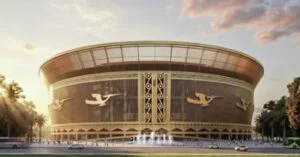
Legends Global’s deal to operate Hanoi’s VinFast-Trong Dong Stadium puts the company in charge of day-to-day venue functions at a site planned for 135,000 people. If completed as planned, it would be the world’s largest stadium used for sport. The announcement is therefore about more than a contract: it points to the operational demands that come with building a venue at an exceptional scale. Capacity can attract attention, but it doesn’t, by itself, make a stadium easy to run or keep busy.
Operations and opening timeline
The agreement with Vingroup, Vietnam’s largest private conglomerate, covers facility management, vendor coordination and on-site operations. The companies also aim to draw major sports, cultural and entertainment events, while Legends will train Vingroup’s venue staff. The stadium is scheduled to open at the end of July 2027.
Those responsibilities span the work that turns a building into a functioning event venue. Facility management concerns the site and its systems; vendor coordination connects the different businesses and services involved in an event; on-site operations deal with how activity is delivered when people are there. The announcement doesn’t set out the detailed division of duties, but the scope indicates that Legends is being brought in to help organize the venue’s operating model, not simply to advise on a single event.
The staff training component is a notable part of that arrangement. A venue can rely on external expertise while it establishes its operating practices, but it also needs people who understand the site and can carry those practices into daily work. Training Vingroup’s staff suggests that building local operating knowledge is part of the plan. That’s a practical consideration for any large facility, where consistent coordination matters across routine maintenance, suppliers and event days.
The end-of-July 2027 opening date gives the project a stated target, not proof that every part of the venue or its operating setup will be ready on that date. Opening a stadium involves more than completing construction: the site’s teams and services need to function together under real conditions. The source doesn’t provide a readiness schedule or describe how the companies will assess that preparation. The distinction matters. A planned opening is a milestone; a reliable event operation is something the venue has to demonstrate.
Why a stadium’s scale changes the job
A planned capacity of 135,000 makes crowd movement and service coordination central operating concerns. At a venue of that size, teams need workable plans for arrivals, entrances, internal circulation, concessions, cleaning and departures. These are ordinary categories of stadium work, but the scale can make small delays more consequential: a slow process repeated across many entry points or service locations can affect the experience across the site.
That doesn’t mean the stadium’s planned capacity alone tells us how well it will perform. Actual attendance will depend on events, demand and how the venue is configured for each use. The source doesn’t say whether 135,000 will be available for every event, or how the stadium will manage different crowd sizes. Those details matter because an operating plan has to work for the event in front of it, rather than for a headline capacity figure.
(and this is the part most people overlook) A stadium is also a coordination problem among organizations. The venue operator, event organizers, vendors and the venue owner may have distinct responsibilities, and their work has to line up on the day. The agreement names facility management, vendor coordination and on-site operations, but doesn’t specify the precise boundaries between the parties. How those boundaries are set in practice will shape whether decisions can be made quickly when an event is underway.
Many large venues use operating arrangements that combine the owner’s resources with specialist management experience. That general model can give a project access to established processes while the owner builds its own team. It can also make clarity essential: staff need to know who is responsible for a decision, how information moves between teams and which procedures apply. The announced training plan may help create that shared understanding, though the source doesn’t describe the curriculum or how long it will take.
Events will test the business case
The companies’ stated aim to attract major sports, cultural and entertainment events reflects a familiar challenge for large venues: the building needs a program of activity, not just a striking capacity. Different event types place different demands on the site and its staff. A sporting event, a concert and a cultural gathering may require different layouts, schedules, vendors and service plans. The announcement identifies a broad ambition, but it doesn’t name bookings or give a timetable for securing them.
That gap shouldn’t be mistaken for evidence that the venue will struggle to find events. It does mean the operating contract and the event strategy are connected but distinct questions. Legends can be responsible for coordinating venue functions, while the companies’ ambition to draw events depends on the wider ability to develop a compelling calendar. For a venue planned at this scale, a steady mix of uses could matter as much to its practical role as the record capacity.
Here’s the thing: a record, if achieved, is a useful point of comparison, but it isn’t a measure of how well a stadium serves its audience or community. The harder test will be whether the site can host events safely and consistently, and whether its operations can adapt to different kinds of use. That’s where staffing, vendor relationships and repeatable procedures become more than background detail. They’re part of the product people experience when they arrive.
What the contract signals
For Vingroup, the agreement brings in an operator with responsibility for several connected functions and a role in training venue staff. For Legends Global, the work places the company in an operating role at a major planned stadium in Vietnam. The announcement doesn’t disclose financial terms, the length of the agreement or further details about the operating structure, so the scale of the commitment can’t be assessed from the available information alone.
If you’re working in this space, the detail to watch is how the companies turn the broad scope into clear operating responsibilities and event plans. The July 2027 target offers a date against which progress can be judged, while the training commitment raises a more lasting question: how much operating capability will sit with the local team once the venue is running? The source doesn’t answer that yet.
This is more significant than it looks. A stadium designed for 135,000 people puts pressure on every layer of venue planning, from the systems that keep the facility working to the teams that coordinate an event. Legends’ appointment gives the project an identifiable operating partner and a training component. Whether that combination produces a venue that can sustain a broad calendar will depend on execution and on events the companies haven’t yet named.
Ambition is clear. The operating record will come later.
The post Legends Global wins operating contract for world’s biggest stadium in Vietnam appeared first on Inside World Football.