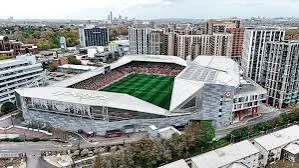
A stadium network becomes matchday infrastructure
Brentford’s agreement with HPE puts the technology group’s stadium network at the center of the club’s matchday digital services. Announced October 30, the partnership follows the network’s deployment at the Gtech Community Stadium. That sequence matters: the announcement describes a relationship built around infrastructure already installed at the venue, rather than a plan whose delivery is still entirely ahead.
Coverage spans the seating bowl, concourses, hospitality areas and stadium perimeter. The network serves supporters, staff, stewards and operations teams during Premier League fixtures, while also supporting digital ticketing. Those uses put the system in the path of several distinct activities: fans accessing services, venue personnel carrying out their jobs, and club operations coordinating activity around an event.
A stadium network can sound like background plumbing. It isn't. When people rely on digital services at the same time and in the same place, connectivity becomes part of the practical experience of attending a match. The network's reach across both public and operational areas suggests that Brentford is treating it as venue infrastructure, rather than as a perk limited to a particular stand or hospitality space.
Why coverage across the venue matters
Stadiums create a demanding setting for digital services. Large groups arrive within a relatively short period, move through different areas, and may all need network access while an event is underway. A system that works well in one section but poorly in another can leave uneven experiences for supporters and make digital processes harder for staff to depend on.
That makes the named coverage areas significant. The seating bowl is where supporters spend much of the match; concourses and hospitality areas serve people moving around the venue or using other facilities; and the perimeter brings the network into the stadium's surrounding operational space. A single network serving these zones has to account for different patterns of use, even if the announcement doesn't explain the design choices or the performance users can expect.
Here's the thing: describing coverage isn't the same as publishing evidence of quality. The announcement establishes where the infrastructure reaches and which groups it serves, but it doesn't provide measures such as connection speed, capacity or service availability. Those details would help show how the system performs under matchday pressure. Without them, the clearest claim is about scope and intended role.
Digital ticketing and the fan journey
The link to digital ticketing gives the partnership a concrete point of connection with the fan experience. Ticketing is one of the services that can turn connectivity from an optional convenience into a practical requirement. Supporters may need to retrieve or present a ticket on a device, while staff need to process attendance and help resolve access problems. A network that reaches the relevant parts of a venue can support that work.
But the network is only one part of the process. Digital ticketing also depends on the club's ticketing systems, the devices people bring, and the procedures used at entry points. If one part of that chain struggles, network coverage alone can't guarantee a smooth arrival. The partnership's stated role is to connect fan services with matchday needs; the announcement doesn't claim that connectivity eliminates every obstacle.
(And this is the part most people overlook.) The value of infrastructure often shows up when nothing noticeable happens: a service remains available, staff can do their jobs, and a supporter doesn't have to think about how data moves through the building. Quiet reliability is harder to promote than a new feature, but it's often what turns a digital service into something people can use routinely.
One network, several audiences
The listed users have different needs. Supporters use digital services as individuals, while staff and stewards need connectivity in the course of venue duties. Operations teams may depend on networked tools to coordinate work across areas. The announcement groups these audiences together, but it doesn't specify which applications each uses or how access is organized.
That distinction matters because a venue network isn't simply a public connection shared without regard to purpose. Similar systems typically have to accommodate different devices, traffic and service expectations across a site. A system serving spectators and operational teams needs to account for that mix. The details of Brentford's implementation aren't in the announcement, so the prudent reading is that the network supports these groups, not that every group receives identical access or tools.
For the club, connecting fan services with matchday operations points to a broader way of thinking about stadium technology. Digital services aren't isolated from the venue around them. They depend on the physical setting, the people working there and the demands of an event. If you're working in this space, the useful question isn't only whether a stadium has a network; it's whether the infrastructure reaches the places and users the club needs to serve.
What the partnership signals
This is more significant than it looks, though the announcement leaves important performance questions unanswered. Brentford has placed a technology partner's network at the foundation of several matchday functions, including digital ticketing. That gives the infrastructure a role in the ordinary mechanics of attending and operating a match, not just in delivering a visible digital feature.
The next measure of success will be practical: whether the system serves people across the areas named, and whether it can support the club's matchday services when the venue is busy. The source doesn't offer usage figures, technical specifications or an account of supporter feedback. Those omissions make it too early to judge outcomes, but they also clarify what the partnership is asking the reader to notice: the network's footprint and its connection to how the club runs a fixture.
And yet, infrastructure alone doesn't make a better matchday. Its contribution depends on the services built on top of it and on how those services fit the routines of supporters and staff. The network creates a base for that work. Whether fans experience a meaningful improvement will depend on what the club can reliably deliver through it.
The post Brentford partner with tech group HPE to boost digital platform on gameday appeared first on Inside World Football.